Tanka Very Much

I hope everyone had a pleasant Valentine’s Day.  If not, here’s an elephant that loves you.*


Valephant

*(It might not love you)


Anyway, thanks to harulawordsthatserve, I have been recently made aware of a traditional form of Japanese poetry known as the tanka.  It is effectively a haiku with an added lower phrase of a 7/7 pair.  Considering the relative popularity of the haiku, I’m a little surprised I’ve not before encountered its extended brother.  But, alas, I have now, and must of course write one.


The Monday Spider
Creeps slowly on the sidewalk.
Should I pick it up?
As I ponder this, it leaves.
I guess it must be Tuesday.


Admit it – you want to write one, too.


Bene scribete.

Watch a Writer Write

My good friend Matt Price alerted me to this interesting item the other day:


It’s a screen-capture video Brandon Sanderson (or Branderson, as I like to call him) posted of himself writing his next book in real-time.  You may know Branderson as the famed author of the Mistborn series and finisher of The Wheel of Time.  Although I have yet to read one of his books, I’ve been greatly impressed by the vast amount of well-received work he’s able to put out.

That’s why this video surprises me.  Seeing him in the writing process, it would appear that he is nearly as obsessive, indecisive, and back-and-forth as I am.  This is honestly painful for me to watch, because it’s too much like seeing myself write (complete with cursor-twitching, shunting stuff below, and pre-chapter notes).  I actually had to stop myself from grabbing at the keyboard and mouse to try and make edits to what he was doing.  With his level of output, I expected him to be a draft-blaster who’d zip through and edit later, but now I’m even more amazed with his productivity.  I suppose he did do 400 words in twenty minutes, though, which if a consistent pace would be nothing to scoff at.

Anyway, if you want to see how one prolific author goes about whipping up a draft (or how I do, for that matter), give it a watch.

As a side note, I am pleased to see that he still double-spaces sentences.  Even if he forgot how to spell ‘oar’.


Bene scribete.

Synopses

While putting the finishing touches on The Amber Ring these last couple weeks, I figured I’d also better throw together a full synopsis for it.

Synopses are kind of a drag.

Not because they’re hard to write – I’ve had more than my fair share of practice summarizing.  It’s because they’re not always easy to keep exciting.  Maintaining something of the flavor and tone of your work while drying it up to its basic elements can be a frustrating task.  I’m certain there are numerous others who can give better advice on the subject than I can, but since I’m here, and so, ostensibly, are you, I’ll go over some of the things I like to keep in mind.

There’s no real easy, short-cut way to approach the whole process, but here are a few points to ponder:


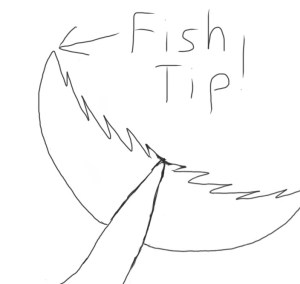
Tip of a fish

Synopsis Considerations


  • A synopsis is typically a two-to-eight page summary of the entire work – the big twists, the ending, everything (important).
  • The editor or agent you’re submitting to might have a specific requirement as to what constitutes a page, but if not, double-spaced 12-point Courier New with one inch margins is a good place to start.
  • The first paragraph is often best utilized in setting up the chief protagonist – who she is, and how she got to where she is when the story begins.  If you already have a pitch line, it might fit nicely in here.  The remaining paragraphs will then recount the events that constitute the story in the order in which they are presented.
  • At least to start with, only include details essential to understanding the main plot; subplots can be added in order of precedence if there is room left in your alloted space and it would make the summary stronger on the whole.
  • The manuscript to synopsis event space ratio can be wildly inconsistent.  Some scenes may take half a sentence, some half a page, depending on how much plot-essential material they contain.  Some scenes can be omitted altogether.
  • Use strong, descriptive, succinct language (because it’s that easy, right?  (>^-‘)> ).  Word economy is paramount.
  • It’s O.K. to be a little conversational; it can help to engage the reader.
  • If you need some ideas on summarizing, look up recaps for TV episodes, or pull up your favorite films on Wikipedia and read the plot sections.  These usually constitute what amounts to synopsis copy.
  • If you’re really stuck on a blank page, you can try zero-drafting (or better yet, dictating if you have speech-to-text software) your initial go by describing the story, stream-of-conscious, from start to finish as you would a good book or movie to a friend.  You can always edit the result up or down as needed, or scrap it and try again.
  • Cheat.  If page format isn’t directly specified, and you’re aiming for a certain length, tweak the margins and line spacing (but preferably not the font) to your advantage.
  • It doesn’t hurt to conclude the synopsis with a poetic statement that encapsulates some important thematic element from the story’s ending.
  • Have someone who has not read your work take a look at the finished synopsis, and ask them if the story when presented thus is easily followable, makes sense, and is free from superfluous material.


Ultimately, a synopsis just serves as a quick overview of a story’s plot to ensure that it’s coherent, original, and interesting.  It doesn’t have to be as brilliantly executed as the manuscript, but anything you can do within its limits to show off the promise of your work will surely be a point in your favor.


Bene scribete.

Letter Palettes

A while back, I talked a bit about what you might consider when naming characters, and today I thought I would follow up by expounding specifically on the topic of pulling words out of your—well, making them up.

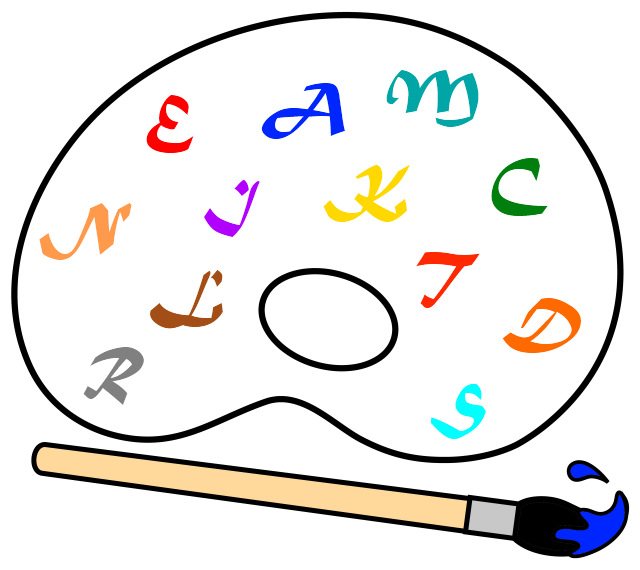
Letter Palette

Uh…


When concocting names for characters, places, or objects, we tend to favor certain sounds.  Where we gravitate is mostly informed by the language(s) we speak, and what we’ve come to associate with pre-established words and names.  Certain phonemes build specific impressions in our minds, and we rely on this context to put together fitting verbal symbols for whatever we’re assigning them to.  Whether or not this is typically done on a conscious level, identifying and mapping out your preferences (both general and circumstantial) can be a useful endeavor.

For instance, my general letter palette would look like this:


+

\

A C D E I K L M N R S T J O Q V X Y Z B F G H P U W


The first column represents what I feel are the most benign letters, and I use them fairly indiscriminately.  The second contains letters that I like at certain times, but aren’t as ubiquitously usable.  The third holds the letters that I tend to avoid.  When my intent is to give a name a rough or unpleasant edge, however, these preferences easily operate in reverse.  The initial and terminal letters of the word will be particularly prone to these guidelines.

Now, this chart is pretty simplistic, containing only letters from the English Roman alphabet and not taking digraphs into account, but you get the idea.  I’m calling it a letter palette (as opposed to a simply phonetic one) because visual aesthetics are also a consideration – sounds can often be written a number of ways, and their appeal can be tweaked as such.

Making a general purpose palette for yourself can be an enlightening exercise, but they become particularly handy when tailored for specific sets.  If, for your story, you need to create a distinct culture with its associated terminology and members’ names, planning out a letter palette for it can help you quicken the process while maintaining a consistent feel.


So, do you find yourself with particular letter preferences?  Could you define your own general palette?


Bene scribete.

Elephants?

Lacking the state of mind required to do a thoughtful post, I shall now write a stupid poem about elephants.


It's an elephant


Elephants are big, they say.
They’re bigger than your face.
They’re smaller than a planet, though,
And can’t survive in space.

Elephants are grey, they say.
They’re whiter than the night.
Yet blacker than the falling snow,
And nowhere near as bright.

Elephants are tough, they say.
They’re tougher than a fly.
Unless that fly is huge, you know,
And equally as sly.

Elephants are shrewd, they say.
They never do forget.
If that is true, then I should go
Before these words upset.


Have a happy new year, everyone!


Bene scribete.

I Hate You, The Slog

The slog hates you

I hate you, the slog.


I hate you, the slog.

I hate you, the slog.

I hate you, the slog.

I hate you, the slog.

I hate you, the slog.

I hate you, the slog.

I hate you, the slog.

I hate you, the slog.

I hate you, the slog.

I hate you, the slog.

I hate you, the slog.

I hate you, the slog.

I hate you, the slog.

I hate you, the slog.

I hate you, the slog.

I hate you, the slog.

I hate you, the slog.

I hate you, the slog.

I hate you, the slog.

I hate you, the slog.


You are not very nice
and now I’ve said it twenty-twice.


Bene scribete.

Novella Excerpt

The first draft of The Amber Ring is completed, and at 98 pages, I find myself with an intended short story that became a novelette that’s now closer to a novella.

It keeps getting bigger.

Oops?


As I work on putting together a presentable second draft for test reading, I thought I would share a short little scene to give a brief glimpse at its protagonist, twelve-year-old Maya Corona.


       As Maya half-attentively filled out the answers to her math test, she found her eyes drifting toward the clock above Ms. Patch’s desk, subconsciously counting down the minutes, as she often did, until the tedium of the school day was over.
       Her wandering eyes also noticed Braden Thomas, who sat at the desk to her right, surreptitiously sneaking a glance at her paper in regular intervals. She contemplated calling him out, or even writing down the wrong answers on purpose, but then decided to just let him cheat. If he could get through school without bothering to learn anything for himself, he would be one less person to pose any real competition for an eventual job, which people were always saying was hard to get these days.
       As she shifted to give him a better view of her exam, she felt something grind against her leg. It was Sofia’s ring; she had left it in her pocket.
       Her mind went unwillingly to the previous night. It had been strange to see Cam again. To think of him without Sofia. His charismatic pluck replaced with that crestfallen timidity. Maya wanted to leave the Fairwoods behind her, and had expected them not to not think twice about returning the favor. Her involvement had been limited to the occasional tag-along with her sister, and she had never done anything of importance there. She had been clear on where she stood, though, hadn’t she? Would they leave her alone, now?
       “Two minutes,” Ms. Patch droned.
       At the edge of her vision Maya saw Braden gripping his pencil tightly, throwing nervous glances her way. Quickly, to his obvious relief, she scribbled down the remaining answers to the test.


Bene scribete.

The Amber Ring

Gold Amber Ring

At the age of ten, Sofia Corona saved the Fairwoods from the malevolent grasp of the Cedar Witch and her goblin army.

Two years later, she drowned unceremoniously in the lake behind her Oregon home.

In the months following the Heroine’s death, when the Fairwoods face a resurgence of goblin attacks, they are forced to turn to Sofia’s cynical twin sister, Maya, for help. But despite an earnest plea from her sister’s faithful gryphon companion, Maya wants nothing more to do with the enchanted land. The request continues to plague her mind, however, and she can’t help but wonder if doing this one last favor will give her the closure she needs to accept her sister’s death and move on with her life.


Such is the premise to my side-project novelette, The Amber Ring, a sort of semi-satirical dark fairytale. I’m just about done with the first draft, and was curious if the concept would appeal to anyone reading this. So – interest piqued? Let me know!


Bene scribete.

Names

Naming characters is an important, sometimes fun, sometimes tricky part of the fiction-writing process, and is something I alternately love and dread.  A name is a symbol that represents someone, both offering identity to those it is attached to, and in turn adopting it from them.

I find that there are generally three ways (or a mix thereof) to come up with and decide upon those monikers:

  • Namesakes.  One simple way to name a character is to do so (in part or in whole) after someone else – someone you know, someone from history, or even another character from some other work.  Such a name will probably already have strong connotations for you, and those might just be appropriate for who you’re writing.
  • Meaning.  The advantage writers have over parents in the naming department is the foreknowledge of who this person or creature they’re creating will be, and can choose a name that is symbolically fitting (or ironically incongruous).  This can be in the form of a name that’s also a word in the operative language (Will, Victor, Dawn, Amber, etc.), a word from another language, or something suitable trolled from babynames.com.  (>^-‘)>
  • Aesthetics.  Often, just focusing on how a name sounds and looks is all you need to do.  I tend to lean mostly in this direction, relying heavily on phonetics when working out what to call characters.  Sounds used together in specific ways can evoke qualities of roughness, delicacy, power, playfulness, and a number of other feelings to subconsciously color the impression of the named.  Spelling should also be a consideration; the visual appeal of different letter arrangements can have the same sort of impact.  All of this goes for whether you’re picking a common name or making up a new one (though I could probably do a whole separate post on the latter!).


However you end up choosing your names, there is one thing I always recommend.


Tip of a fishName Your Characters As Soon As Possible.

The less you’ve decided about a character, the easier it is to settle on a name.  At least that’s always been the case for me.  Sometimes, the name will even help slightly with further direction!

The more important a character is, the more true this becomes.  If you have a strong image of the character in mind by the time you start thinking seriously about what to call them, picking a name that feels right can be a daunting task.  It means you have all the more context and nuance to map to that all-important referential symbol.  It’ll seem like you have to find a name that already represents all facets of the character, rather than letting the name come to do so naturally as the character develops.


But what about you?  Do you agonize over the subtleties of your characters’ names?  How do you like to go about choosing them?


Bene scribete.