Font Squirrel

Squirrely


I’m not the biggest fan of squirrels, but…but I do like fonts.

Fonts are important in graphic design work, because writing text by hand is obnoxious and imprecise if you’re not a talented calligrapher.  If you are, then…well…good for you.  For the rest of us, looking for an appropriate typeface can sometimes be a tricky endeavor.

Font Squirrel makes it a little less tricky.  There are a lot of “free” font collection websites out there, but you have to be careful with most of them – a lot of the time what they’ll really indicate is “free for personal use”, which means go ahead and download and tinker around with them, but don’t get caught using them on anything in a professional capacity.  Font Squirrel, however, makes sure to stock only those typefaces which permit commercial usage for free, so you can browse their entire collection without worrying about licensing restrictions.

Fonts are organized by category, and each font has its own page with pertinent stuff, like its character set, example sentences, and even a tryout section to see how your own text looks in it before committing to the download.  For the handful of fonts that aren’t allowed to be re-hosted, a link to the font owner’s website is provided.

Anyway, it’s a handy resource for the budget-minded who get/want/need to design their own covers and promotional materials, and are looking (rightfully so) for a little more flair than the basic operating system defaults provide.  But, please, if you’re also handling the typesetting – for your readers’ sake, don’t get fancy with the interior font.  (>^-‘)>


Bene scribete.

ANGER CLEANING!

Whew.  This was an exhausting week, creatively speaking.

Ever get hyper-frustrated with something about your writing (or art (or music)) that just won’t turn out right, no matter how long you stare at it and how much you tweak it?

Of course you do.


Tip of a fishToil Your Fury Away.

Most of the time, in those instances, the best thing to do is to step away for a while.  But you can’t just do nothing – no, you’re upset because that lack of progress is making you feel unproductive, and just sitting on that pent-up irritation energy won’t do a whole lot to wind it down.

So!  Find an important, monotonous drudge of a task (that maybe you’ve been putting off) to do around the house, and do it angrily.  You’re already in a bad mood, so what could it hurt?  Cleaning is an easy fallback; it’s just one of those things that can almost always stand to be done (particularly if you live with messy people).  But reorganizing, repairs, yardwork – it’s all good, so long as it can occupy you for a half-hour or more.

Whatever the task, throwing yourself into it can be cathartic.  It won’t be taxing on your tired brain, and it will be a welcome redirection of focus (which confers the added bonus that you’ll do a better job at it than you would have if you were approaching it in the normal, reluctant, eager to get it over with manner).  On the other side of things, repetitive physical work can be conducive to creative thinking, so you may just find yourself with a new idea or two.  In any case, it will use up your anxious fervor, and when you’re done, you’ll know that you’ve accomplished something – an often desperately needed feeling.


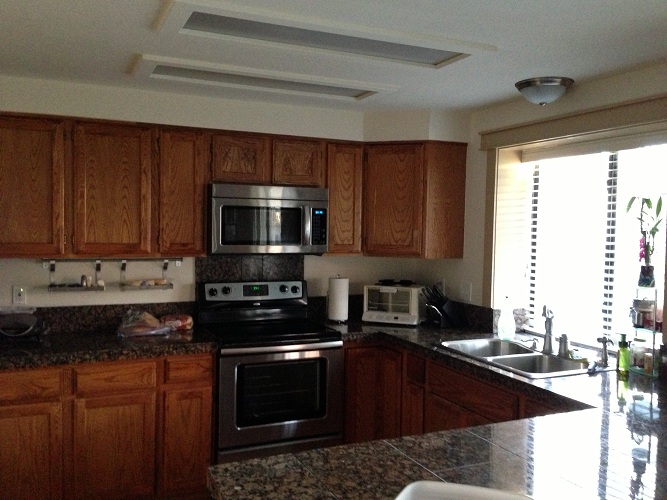
I spent a couple of hours anger-cleaning my kitchen today.


Cleeeaaaan

Some of it fits in a photograph.


And now, order is restored.

(Although, to be fair, the source of the rage-fuel in this particular instance was primarily the messiness itself…but still)

Bene scribete.

Tanka Very Much

I hope everyone had a pleasant Valentine’s Day.  If not, here’s an elephant that loves you.*


Valephant

*(It might not love you)


Anyway, thanks to harulawordsthatserve, I have been recently made aware of a traditional form of Japanese poetry known as the tanka.  It is effectively a haiku with an added lower phrase of a 7/7 pair.  Considering the relative popularity of the haiku, I’m a little surprised I’ve not before encountered its extended brother.  But, alas, I have now, and must of course write one.


The Monday Spider
Creeps slowly on the sidewalk.
Should I pick it up?
As I ponder this, it leaves.
I guess it must be Tuesday.


Admit it – you want to write one, too.


Bene scribete.

Watch a Writer Write

My good friend Matt Price alerted me to this interesting item the other day:


It’s a screen-capture video Brandon Sanderson (or Branderson, as I like to call him) posted of himself writing his next book in real-time.  You may know Branderson as the famed author of the Mistborn series and finisher of The Wheel of Time.  Although I have yet to read one of his books, I’ve been greatly impressed by the vast amount of well-received work he’s able to put out.

That’s why this video surprises me.  Seeing him in the writing process, it would appear that he is nearly as obsessive, indecisive, and back-and-forth as I am.  This is honestly painful for me to watch, because it’s too much like seeing myself write (complete with cursor-twitching, shunting stuff below, and pre-chapter notes).  I actually had to stop myself from grabbing at the keyboard and mouse to try and make edits to what he was doing.  With his level of output, I expected him to be a draft-blaster who’d zip through and edit later, but now I’m even more amazed with his productivity.  I suppose he did do 400 words in twenty minutes, though, which if a consistent pace would be nothing to scoff at.

Anyway, if you want to see how one prolific author goes about whipping up a draft (or how I do, for that matter), give it a watch.

As a side note, I am pleased to see that he still double-spaces sentences.  Even if he forgot how to spell ‘oar’.


Bene scribete.

Reindeer Drama: Part -1

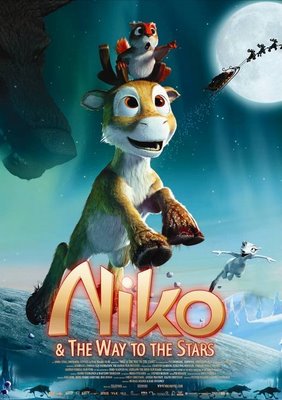
Last month, I talked about a Finnish animated film depicting complicated family turmoil among flying reindeer.  It was a sequel to a movie entitled Niko and the Way to the Stars – one which, after being exposed to the second, I found it necessary to track down.  Having successfully done just that, I suppose it is only appropriate that I should follow up here.


Niko poster


The animation isn’t as sharp as in the second film, but it’s still pretty decent, and the detail they squeeze in despite the low tech is impressive at points.  The English dub is mostly serviceable.  But we’re not here to talk about the technical details…

As you may recall from last time, our little protagonist Niko’s parents have split custody of him in the sequel, and mom shacks up with a new caribou.  This left me with certain expectations of some kind of rocky reindeer divorce occurring in the first.  But the reality, as it turns out, may be even better.

Let’s take a look at the Wikipedia page for Santa’s reindeer.  Niko has an entry on it.  It states, and I quote, that he is:


Prancer’s illegitimate child from a one-night stand with a regular reindeer.


That…is awesome.  I mean, there’s just something kind of fantastic about the blunt, offical candor of a statement like that when considering the subject matter.  And aren’t those links helpful?

So, how do flying reindeer by-blows happen?  When the film begins, Niko is already aware that his father is one of Santa’s crew, but his mother refuses to tell him which one.  She also openly admits to him that she never bothered to tell his dad that he exists.  Real nice.  She explains that she got cozy with him one night when Santa’s sleigh “broke down” nearby (I’ll pause a moment to let you consider what constitutes the ‘engine’ of this particular magical flying sleigh, and subsequently the implications of this claim).  Smooth, Prancer.  Smooth.

Anyway, on to the story.

While gallivanting around in preadolescent reindeerhood, Niko is spotted by a prowling wolf, who naturally wants to turn him into not being hungry anymore.  Niko, being a little reindeer, runs back to his herd for protection.  The wolf, being a predator, follows.  Rather than killing the crap out of this singular wolf, however, the adult reindeer opt instead to run away forever, because apparently they are terrible at being large spiky-headed hoofy-legged animals (there’s a reason wolves hunt lone ungulates in packs).  Since the herd is now displaced, it decides collectively to hate Niko for leading a wolf to its territory.  Since little reindeer don’t like being hated by everyone they know, Niko decides to run away during a snowstorm and track down his father.  Niko’s mother at first wants to go after him, but she is easily talked out of it by another reindeer, deciding that letting her son’s squirrel sidekick try to find him and bring him back safely is good enough.  Reindeer mom of the year.

When Niko finally makes it to Santa’s workshop, he confronts the flying squad in their reindeer tavern (yes, that’s a thing).  When he asks if any of them remember hooking up with a normal caribou one Christmas night, they tell him that he’ll have to be a lot more specific than that.  This means exactly what you think it does.  Santa’s eight are hotshot rock-stars in the reindeer world, and they don’t shy away from picking up a few groupies here and there.  You know, that…actually makes too much sense for raillery.  Niko clarifies his mother’s identity and drops the bomb that one of them is his father, but their response for the time being is feigned ignorance and wholehearted denial.  Why does nobody want this adorable little reindeer kid?
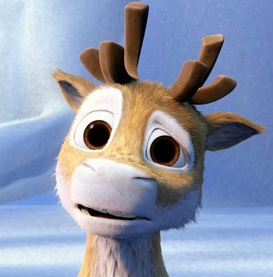
 

RNDR FCE!!!

That face. It’s glycerin.


Let’s talk about the villain.  Ooh, let’s!

He is the leader of a pack of wolves who’ve fallen on hard times.  His goal is to eat Santa’s reindeer.  Because – are you ready? – he believes, for no discernible reason, that doing so will grant him their ability to fly.  And then.  He aims to eat Santa Claus himself.  And then.  He intends at last to take Santa’s place so he can FLY AROUND THE WORLD AND EAT EVERY CHILD EVER ON CHRISTMAS.  I–ghh–bvv…  This is possibly the best and most insane motivation I have ever seen for an antagonist in a Christmas or children’s movie.

Then, there is a pink poodle who is inexplicably lost and on her own in the north pole, and even more inexplicably knows the way to Santa’s secret workshop.  She runs into the wolves and they make her lead them there.  The one semi-intelligent non-jerk wolf in the group, likely realizing his pack is entirely male, runs off with her.  Now I want to see what a woodle (a poolf?) looks like.

I could go on, but there’s simply too much and I can’t describe it all coherently.  Just find it and watch it.  It’s madness.  In the meantime, I’ll leave you with seven more things you should know about Niko and the Way to the Stars.


  • Niko is the same size and seems to be only slightly younger in this than he is in the second, which takes place at least a year later.  I’m guessing this is because, as the son of Prancer, who is ostensibly immortal, he ages much more slowly than a regular caribou would.
  • The ermine randomly breaks out into song in this one, and is generally psychotic.  I guess they dropped that particular direction for the second.
  • Why is Vixen male?  At least Donner and Blitzen have German accents.
  • Niko’s squirrel morbidly creates snowsquirrels of his wife and kid to keep himself company, because the real ones were eaten by wolves.
  • The gateway cave to Santa’s workshop is a perilous Indiana Jones-style death trap.
  • At one point, when Prancer gets knocked out, the squirrel sodomizes him with an icicle to wake him up.
  • Toward the end, Santa’s reindeer warp into outer space with the wolf leader, and then drop him from orbit (maybe that’s the way to the stars?).


Bene scribete.

Synopses

While putting the finishing touches on The Amber Ring these last couple weeks, I figured I’d also better throw together a full synopsis for it.

Synopses are kind of a drag.

Not because they’re hard to write – I’ve had more than my fair share of practice summarizing.  It’s because they’re not always easy to keep exciting.  Maintaining something of the flavor and tone of your work while drying it up to its basic elements can be a frustrating task.  I’m certain there are numerous others who can give better advice on the subject than I can, but since I’m here, and so, ostensibly, are you, I’ll go over some of the things I like to keep in mind.

There’s no real easy, short-cut way to approach the whole process, but here are a few points to ponder:


Tip of a fish

Synopsis Considerations


  • A synopsis is typically a two-to-eight page summary of the entire work – the big twists, the ending, everything (important).
  • The editor or agent you’re submitting to might have a specific requirement as to what constitutes a page, but if not, double-spaced 12-point Courier New with one inch margins is a good place to start.
  • The first paragraph is often best utilized in setting up the chief protagonist – who she is, and how she got to where she is when the story begins.  If you already have a pitch line, it might fit nicely in here.  The remaining paragraphs will then recount the events that constitute the story in the order in which they are presented.
  • At least to start with, only include details essential to understanding the main plot; subplots can be added in order of precedence if there is room left in your alloted space and it would make the summary stronger on the whole.
  • The manuscript to synopsis event space ratio can be wildly inconsistent.  Some scenes may take half a sentence, some half a page, depending on how much plot-essential material they contain.  Some scenes can be omitted altogether.
  • Use strong, descriptive, succinct language (because it’s that easy, right?  (>^-‘)> ).  Word economy is paramount.
  • It’s O.K. to be a little conversational; it can help to engage the reader.
  • If you need some ideas on summarizing, look up recaps for TV episodes, or pull up your favorite films on Wikipedia and read the plot sections.  These usually constitute what amounts to synopsis copy.
  • If you’re really stuck on a blank page, you can try zero-drafting (or better yet, dictating if you have speech-to-text software) your initial go by describing the story, stream-of-conscious, from start to finish as you would a good book or movie to a friend.  You can always edit the result up or down as needed, or scrap it and try again.
  • Cheat.  If page format isn’t directly specified, and you’re aiming for a certain length, tweak the margins and line spacing (but preferably not the font) to your advantage.
  • It doesn’t hurt to conclude the synopsis with a poetic statement that encapsulates some important thematic element from the story’s ending.
  • Have someone who has not read your work take a look at the finished synopsis, and ask them if the story when presented thus is easily followable, makes sense, and is free from superfluous material.


Ultimately, a synopsis just serves as a quick overview of a story’s plot to ensure that it’s coherent, original, and interesting.  It doesn’t have to be as brilliantly executed as the manuscript, but anything you can do within its limits to show off the promise of your work will surely be a point in your favor.


Bene scribete.

Reindeer Drama

So the other day at my sister’s place, while scrolling through Netflix in search of something ridiculous to watch, we stumble upon this curious item:


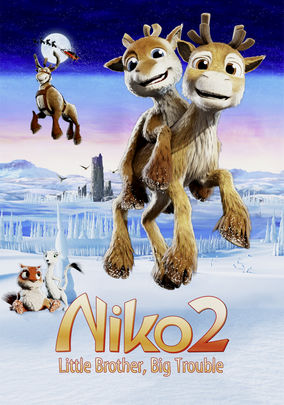
Niko 2


We initially click on it because we think we’re looking at a two-headed reindeer (alas, it was only a small reindeer being ridden by a smaller reindeer).  But then.  But then!  We read the description:


On Christmas Eve, young reindeer Niko’s world seems shattered after his mother remarries and he’s blamed when his new stepbrother is kidnapped.


I don’t even…  Reindeer drama?  What?  How could we not watch this?

Anyway, it gets better.

It turns out that the eponymous Niko can fly because his real dad is Prancer.  Prancer.  Do you get what that means?  One of Santa’s magical caribou couldn’t make his reindeer marriage work, and is now an every-other-weekend dad.  I can’t get over how starkly…modern that notion is given the context of a kids’ Christmas story about flying reindeer.  And the giant “2” on the cover tells us there was a movie before this one – was it about little Niko suffering through his parents’ (one of whom, once again, is Prancer!) messy reindeer divorce?  I like to imagine so.

The movie begins with Niko returning home from a visit with his dad to find that his mother has shacked up with her new cari-beau (…O.K., that was awful).  If that weren’t enough to dump in a kid’s lap overnight, the new guy has a younger son of his own, and mom is already pregnant with another.  Yet this isn’t even a wicked stepparent thing – the stepdad is a really nice guy.  Am I seriously watching a mature portrayal of split-family dynamics in a reindeer cartoon?

Niko himself is grudgingly adorable (even with his strangely reptilian nose).  You’d think, being the only flying reindeer in his herd, that he’d be a typical acceptance-craving misfit protagonist.  But, no.  Enjoying solitude, he envies the life of a hermit he meets, and actually utters, in chipper earnest, “I wish that nobody knew I existed.”  Yikes!


Some reindeer

That’s pretty f-d, kid


The central conflict is mostly forgettable (aside from its own strangeness), involving a wolf who for some reason lives in a high mountain cavern with a bunch of eagles who for some reason carry her around and are her devout servants.  This wolf, we learn, wants revenge on Niko for apparently having killed her brother in the first film (I presume as a way to lash out against his parents’ split-up).

The film is Finnish, and while the visuals were expectedly not on par with the Pixar/Dreamworks standard, I’d place them only one tier down.  There was some interesting detail (the reindeer, while still hyper-cute-ified, looked more like actual caribou than any other animated reindeer I can think of), the wingless flight physics were oddly amusing, and the mouth-sync looked to be re-rendered for the English dub.  No one could seem to agree on how to pronounce the names, though.

I’m not sure where I’m going with all this; I suppose I just enjoy incredulity.  So should you watch this thing?  I don’t know.  But yes, you probably should.

I’ll leave you with five more things you should know about Niko 2:

  1. I feel like it takes place in a world where humanity has disappeared, but the reindeer have taken over running Santa’s shop because they don’t know any other way of life.
  2. When you finally do see Santa, he is wearing a starry-night cape.
  3. There is an ermine (not a particularly endearing ermine, but an ermine nonetheless).
  4. For some reason, Niko learns how to go starship-style warp-speed at the end.
  5. All of this is about an animated kids’ magical flying talking Christmas reindeer movie that was actually made, and exists, here on Earth, in this reality.


Bene scribete.

Letter Palettes

A while back, I talked a bit about what you might consider when naming characters, and today I thought I would follow up by expounding specifically on the topic of pulling words out of your—well, making them up.

Letter Palette

Uh…


When concocting names for characters, places, or objects, we tend to favor certain sounds.  Where we gravitate is mostly informed by the language(s) we speak, and what we’ve come to associate with pre-established words and names.  Certain phonemes build specific impressions in our minds, and we rely on this context to put together fitting verbal symbols for whatever we’re assigning them to.  Whether or not this is typically done on a conscious level, identifying and mapping out your preferences (both general and circumstantial) can be a useful endeavor.

For instance, my general letter palette would look like this:


+

\

A C D E I K L M N R S T J O Q V X Y Z B F G H P U W


The first column represents what I feel are the most benign letters, and I use them fairly indiscriminately.  The second contains letters that I like at certain times, but aren’t as ubiquitously usable.  The third holds the letters that I tend to avoid.  When my intent is to give a name a rough or unpleasant edge, however, these preferences easily operate in reverse.  The initial and terminal letters of the word will be particularly prone to these guidelines.

Now, this chart is pretty simplistic, containing only letters from the English Roman alphabet and not taking digraphs into account, but you get the idea.  I’m calling it a letter palette (as opposed to a simply phonetic one) because visual aesthetics are also a consideration – sounds can often be written a number of ways, and their appeal can be tweaked as such.

Making a general purpose palette for yourself can be an enlightening exercise, but they become particularly handy when tailored for specific sets.  If, for your story, you need to create a distinct culture with its associated terminology and members’ names, planning out a letter palette for it can help you quicken the process while maintaining a consistent feel.


So, do you find yourself with particular letter preferences?  Could you define your own general palette?


Bene scribete.

Elephants?

Lacking the state of mind required to do a thoughtful post, I shall now write a stupid poem about elephants.


It's an elephant


Elephants are big, they say.
They’re bigger than your face.
They’re smaller than a planet, though,
And can’t survive in space.

Elephants are grey, they say.
They’re whiter than the night.
Yet blacker than the falling snow,
And nowhere near as bright.

Elephants are tough, they say.
They’re tougher than a fly.
Unless that fly is huge, you know,
And equally as sly.

Elephants are shrewd, they say.
They never do forget.
If that is true, then I should go
Before these words upset.


Have a happy new year, everyone!


Bene scribete.