The Tower of Boran

I’d like to welcome my good friend, Shauna Scheets, to WordPress!

Her debut novel, The Tower of Boran, released this week.


"The Tower of Boran" by Shauna Scheets

In the night sky over Caillte Saíocht, not a single star shines, and those who live below it must fear the corrupting touch of night-fever. The crystal gleam cast from the Tower of Boran is all that stands between the realm and utter darkness, but its power has long been fading.

On her sixteenth birthday, Seraetia prepares to be named a priestess of the Sanctum, destined to restore the tower’s light. As the events of this long-awaited day unfold, however, she learns that not everything is as it appears. With the life she thought she knew rapidly unravelling around her, Seraetia must ally with those who know the truth behind the land’s peril, and fight to save her home from something darker than the night.


As a special promotion, the Kindle version will be free to download all day tomorrow (September 30).


Bene scribete.

Out Loud

Errors in text can sometimes be hard to find.  Not the big and ugly ones, but the little, seemingly innocuous oversights, like missing or repeated words.  It’s because the mind wants to find meaning, and it will readily compensate for what it feels is close enough.

For istnacne, msot of yuo wlil prboblay be albe to
to raed tihs wtihuot any graet mnetal eforft.

It’s normally a good thing, but maybe not so helpful when you’re trying to get some copyediting done.  One way to compensate – have it read aloud to you.  But I don’t mean by another person.


Tip of a fishTalking Computers = Neat.

Unlike a person, a speech synthesis program has no context or expectation-bias, so it will read everything on the page in a literal, straightforward manner.  Feeding your text through one can be very handy for catching those last little silly errors, and just hearing your story spoken back to you can be useful for a number of other reasons (not to mention the entertainment value of having it done in a droning, not-quite-right electronic voice).

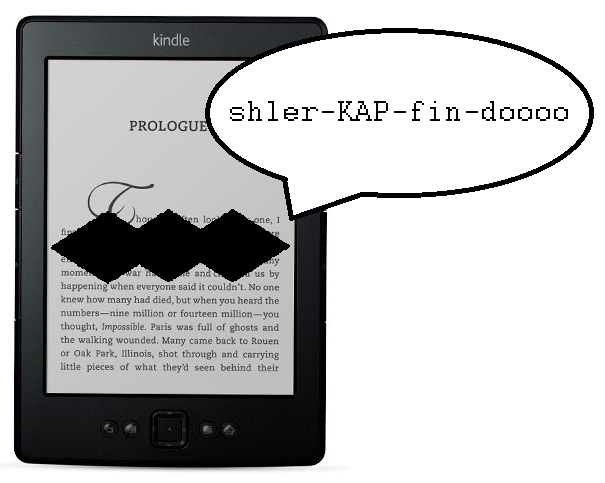
Most computer (or phone, for that matter) operating systems come with speech synthesis these days, but there are also plenty of websites and free downloadable programs out there which will do the trick.  My personal favorite is Amazon’s Kindle e-reader, which has a pretty competent one built in.  Rather than printing my drafts out, I like to convert them for the Kindle to get a more natural and focused read-through, and the option to have it speak it is right there, so it works out nicely.

It’s also funny to hear it pronounce every single one of the proper nouns correctly…except for the most important ones (i.e., any of my protagonists).  (>^-‘)>


Kindles can talk

The word was ‘dragon’, Kindle.


There isn’t a perfect text-to-speech program out there yet, but they’re still fun to play around with, and can make for a handy utility in your writing arsenal.  What means have you found work best for catching all your typographical blunders?


Bene scribete.

Halfway There (…maybe)

I finished the first legitimate draft of Chapter 8 of The Book this week.  It’ll need another draft before it’s presentable, since I want to change a few elements, but it’s brought me to the cusp of 60,000 words.  If this is roughly the midway point, then the overall length should be about what I expected.


So many pages...

Or, knowing me, it could end up like this


Although the writing process itself has gone smoother, these last two chapters have really been taking their time coming out of me, each turning into month-long endeavors.  I suppose it’s because the plot is ramping up, and there are several important scenes (one of them the longest, yet) to which I’ve paid more-than-usual detail in an effort to ensure certain things are getting across properly.  It remains to be seen whether or not those efforts have been successful, but I’m sure there will be plenty more tweaking to come.

It’s always an interesting contrast.  The further along the story, the better the grasp on the plot and characters and the easier the ideas come, but at the same time, the harder it gets to juggle everything in a precise and cohesive manner.  I’m curious to hear other writers’ thoughts – do you find it easiest to write at the beginning, when your concept is still unpolished but you have more freedom, or do you have a better time toward the end, when your path is narrower but the direction is clearer?


Bene scribete.

Zero Drafting

Last week, I talked about a writing exercise that helps get my brain working faster when my pace has slowed to a crawl.  After spewing out a lot of nonsense that way, I wanted to see if I could apply that high-output word vomit toward something a little more productive, and eventually gravitated toward my current approach of beginning with a hectically speed-written, gloriously sloppy version of each scene in The Book.  A “Draft 0”, if you will.

The basics of zero-drafting are similar to the exercise, only the goal is to try to follow the points of your story-planning rather than letting your mind lead you at random.  You still write as quickly as you can without stopping; the garbage can be cleaned out later.  I started by only doing ten minutes at a time, taking a short break between stints, then moved on to doing a whole scene at once, and now I’ll do an entire chapter in a single go (usually about a two-hour endeavor).  The immediate results are truly cringe-worthy, but that’s O.K.  No one else has to look at this stuff (…for real, this time!).  It gives you a basic framework to follow for the first legitimate draft; some passages will have to be tossed, but many might only need a little editing, and you may even find that the narrative took a few unplanned but ultimately beneficial turns because of the pressure and spontaneity – ideas that could have been missed if you had instead plodded carefully through the first run with an overfocused mind.

Because of my deep-seated need for precision and my perpetual worry of screwing things up, there’s always a build-up of anxiety before I start a draft 0, but once I get rolling with it, it’s extremely liberating.  Regardless of how terrible it is when finished, it’s still a big step forward in the process of getting the book together, and it actually leaves me with a sense of accomplishment.  That’s not something to take for granted; in a solitary activity like writing, self-encouragement is imperative to sticking with it.

In any event, the issue at core here is the subject of today’s Fish Tip.


Tip of a fishWrite First.  Edit Second.

It has to be some sort of writing axiom.  Things tend to go a lot more smoothly if you get your ideas down first, and then organize them afterward.  If you edit first, and only write down a sentence after you’ve revised it several times mentally, then the process slows dramatically, and you leave yourself at the mercy of the slog (not to mention it will likely need to be edited again, anyway).

It’s a sentiment we’re all familiar with, I’m sure, but it’s something that certainly still gives me trouble.  One of those things that’s easier said than done!


Bene scribete.

Writing Exercise

If, like me, you’re constantly bogged down by the slog, then you probably understand the frustration that comes with, well, writing too dang slow.  In an effort to take the fight to the troublesome pest and kick that writing into motion, I’ve come up with a little exercise (though I’m sure I’m hardly the first to do so) to help encourage getting those words down more freely.

It’s fairly simple.  Take a character from your story, pick a starting place or incident, and then write without stopping for ten minutes.  Without stopping.  Don’t correct mistakes, don’t touch backspace, don’t think too hard, just follow the flow of your thought process.  Write whatever pops into your head, as quickly as you can; if your mind is only a sentence ahead of your hands, you’re doing great – you might be surprised what your brain will come up with when you force it into high gear.  It doesn’t have to be canonical, it doesn’t have to be good, it doesn’t even have to make sense, so long at the end of those ten minutes you have something that vaguely resembles a chunk of narrative (I’ll usually get around 500-600 words).  The best part is that you can tell your self-consciousness to take a hike, as you never have to show these to anyone.


So here’s one of mine that I’ll show to everyone.  (>^-‘)>  I started with the primary protagonist from The Book, put her next to a river, and everything else just came as I typed.

  The vermillion dragon lay peacefully next to the riverbed, organizing sticks in a star-like pattern, setting the end of each one next to the middle of the one before, at a slight angle so that the entire design would be saw-like. The last one was imperfect, so she began again.
  “Um…hello?” a gentle voice appeared beside her.
  Xenasi started, turning her head to look at the one who invaded her solace. It was a deer.
  “I am a deer,” said the deer.
  “I see that you are…” she said warily. “Though I’m not sure why you can speak.”
  “I am the kind of deer that can talk,” he said bashfully.
  “There is such a thing?”
  “Before you stands proof that there is.” He slumped down into a sitting position. “I have a problem.”
  “Why would you approach a dragon with a problem? Would it not occur to you that I might rather eat you than help you?”
  “It occurred.” He squinted and wrenched his face and looked away. “But I thought that you wouldn’t.”
  Xenasi blinked. “I…I guess I already ate. What should I call you?”
  “Malbulous,” the deer sighed.
  It was a ponderous name. Though it seemed unlikely to be the source of his problems. “What is this problem that you would approach a dragon to help?”
  “Well,” the deer whapped a hoof against the ground in frustration. “Well, my super-awesome-doe-girlfriend left me.
  “And…what? Why…um…what?”
  “She left me for another deer. A stupid buck whose antlers are way too big and he’s probably trying to compensate for something with them. So, anyway, I want you to eat him instead of me. He is bigger than me, so you’ll have a much more satisfying meal. I promise.”
  Xenasi had just told the deer that she had already eaten, so she was not sure how to respond. I suppose I could stash the carcass for later. “I suppose I can help you. Where is this other buck?”
  “Just down the river a way,” replied Malbulous. “If you hurry, you can probably catch him. He’s probably just…getting all over my doefriend.” He got up, but only so his subsequent sulk would have more room to express itself.
  “What about your girlfriend? Do you want her alive?”
  “Of course…”
  Xenasi stood and shook off for some reason. “What are you prepared to offer me for this favor?”
  “The tasty body of that stupid doe-stealing buckhead. Remember?”
  “Well, I thought getting that would just come out of doing that,” the dragon nonsensed.
  The deer began to gallop away. “This waaaaaaaay!”
  Xenasi narrowed her eyes, but spread her wings and took flight, easily outpacing the deer and making her way down the river, eyes searching for the other buck of whom he spoke.
  It was only after a few minutes that she came across him, getting all cuddly with the doe who was once with Malbulous. Unsure of why she was cooperating, Xenasi swooped down and lunged at the unsuspecting buck. The buck jumped in fright, and tried to dart away, but was not so fast as the approaching dragon, and came to meet his end below her claws and between her teeth.


That’s the kind of thing that I end up with when I do these.  Just a stupid little passage written spontaneously while barreling over the slog.  I hope it goes without saying that it’s not an accurate representation of the character or my finished writing.  (>^-‘)>  Or would have gone, as I just said it.  You know what I mean.

Anyway, it’s something that helps me loosen up a little when I’m feeling brainclogged.  What kind of techniques do you use to battle your inhibitions?

Next time, we’ll take a look at extending this exercise into zero-drafting.  Until then, bene scribete.